Three Ways to Handle a London Landmark
Bloomsbury's Imperial has reopened after a ten-year rebuild that celebrates the concrete that replaced its Victorian original. Around the corner, the Kimpton Fitzroy has redecorated. In Piccadilly, Fattal has simply bought the lease.
Charles Fitzroy Doll designed two hotels on Russell Square. One of them still looks like his: turrets, terracotta, a 19th-century tiled zodiac floor in the lobby. The other was demolished in the sixties and replaced by a concrete slab that Londoners spent five decades apologising for. The interesting decision of this year is that The Imperial, reopening after a refurbishment that ran for ten years, has decided to stop apologising.
The Imperial: restoring the wrong century, on purpose
The original Imperial opened in 1904 with Turkish baths, a winter garden and public rooms lined in marble and granite. All of it went. What replaced it was a modernist structure with a geometric window rhythm and a facade that the industry has long treated as a liability to be clad over at the first opportunity. Cube Design, the architects on this rebuild, have instead treated the sixties building as a historic layer in its own right, which is how Jane Lock-Smith of Cube Interiors puts it, and the interiors by Trevillion Interiors and Keane Brands follow that lead rather than fighting it.
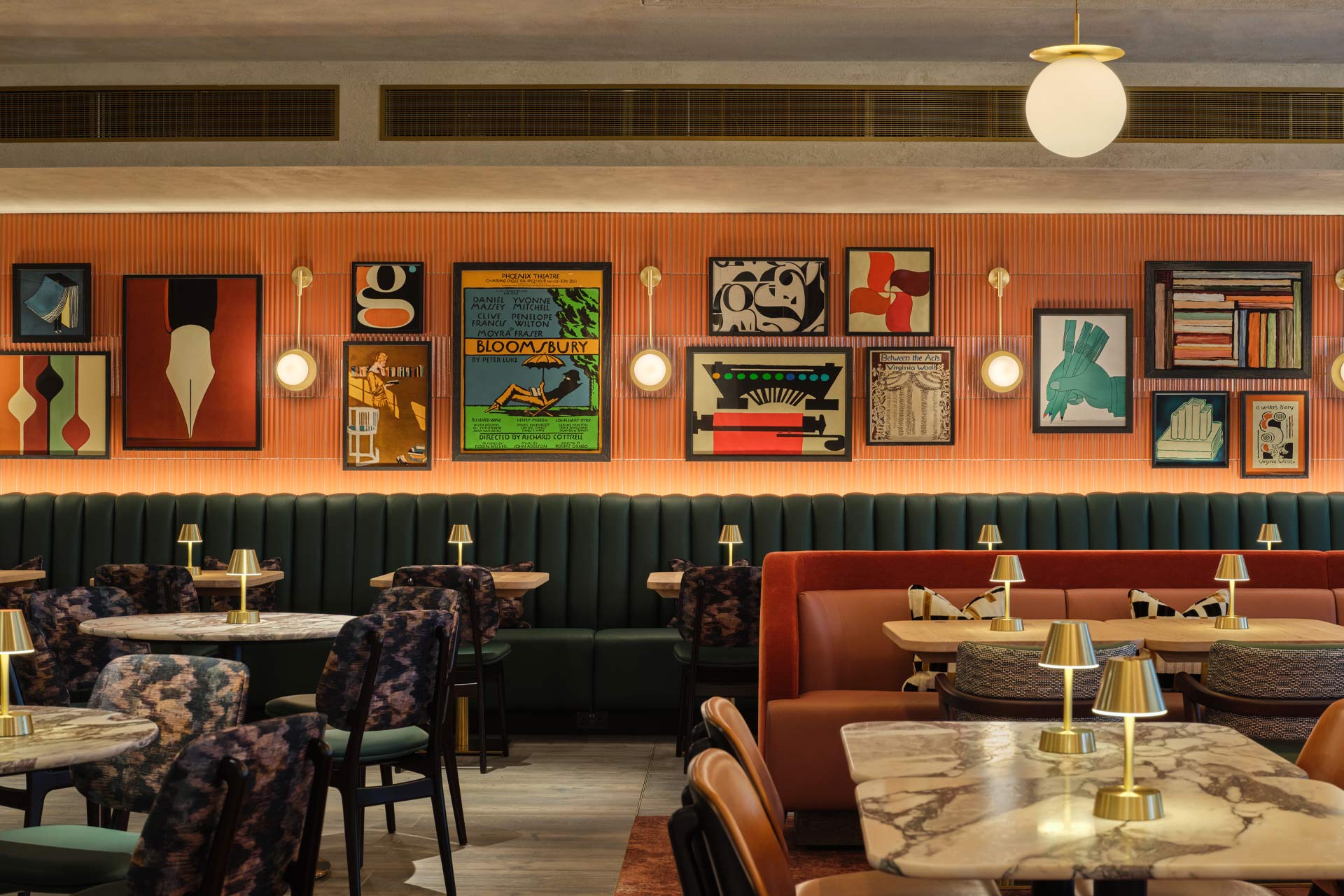
The evidence is in the detail. Burnt orange glass tiles found in the mezzanine floor during the works set the warm palette used across the property. Terrazzo appears in places you would not expect it. There is wood panelling, sculptural lighting, mid-century furniture with soft edges, and more than 500 original prints from Adam Ellis Studio Art House hung through the guestrooms and public areas as structure rather than decoration. Three hundred and fifty-seven rooms and suites, most of them keeping the geometric windows that frame Russell Square, some with private gardens and outdoor tubs.
This is Imperial London Hotels' first lifestyle property, and it shows in the parts that could tip into gimmick: GPO Audrey phones in the rooms, Chopper bikes to borrow, board games and magazines chosen by local collaborators. Read the press material and it sounds like a checklist. Encountered in sequence, on a floor where the palette holds, it reads as a coherent argument about a decade. What genuinely earns its place is the Bell Room and Terrace, where the Victorian building's galleon, clock and bells survive from the turret that no longer exists. That is the hotel admitting what it destroyed.
At the top there is Arcus, a rooftop bar and restaurant of 327.1 square metres with near 360-degree views and, according to the hotel, the only such rooftop in Bloomsbury. Expect it to be the hardest table in the building for the first year and the least representative of what the refurbishment achieved.
The brave move was not restoring the 1904 building. It was refusing to pretend the 1904 building was still there.
The Kimpton Fitzroy: a redecoration, honestly scaled
Doll's surviving Russell Square hotel has done something smaller and has not oversold it. The ground floor has been reworked from lobby and reception through Fitz's Brasserie, The Parlour, The Snug and the seasonal Summer Terrace. Emily Gunning's scheme puts seating nooks around the grand staircase, warm reds and yellows and greens in the entrance, mohair, distressed brass, dark timber, curved upholstery drawing on Art Deco and mid-century sources. The Snug goes deeper in colour and reads residential.
Gunning is right that the building should lead, and the zodiac floor is left to do its work. Fitz's Brasserie leans on the story that Doll also designed the First Class dining room on the RMS Titanic, said to have replicated this room. It is a good line. It is also a redecoration of a ground floor, presented in the current vocabulary of the hotel as third space, which usually means the lobby needs to earn revenue between check-out and check-in. Nothing wrong with that. It is not a ten-year rebuild.
Piccadilly: the deal, not the design
The third London story this season involves no designer at all. Fattal Hotels has paid a reported GBP 66.5 million to the Crown Estate for the long leasehold of the Dilly in Piccadilly, a hotel it has run since 2022, when it bought the operations from APG Asset Management and Singapore's GIC in a GBP 90 million deal. The building is part way through a phased renovation due to complete in 2028.
Buying the lease under a hotel you already operate is the least glamorous move of the three and probably the most consequential. Fattal has taken more than 60 hotels across Europe since 2022, including 12 in the Netherlands with the Zien Group, and has since moved into Manhattan with the 117-room Blakely and onto Lake Geneva with the former Hilton Evian. Control of the asset is what lets an operator spend a decade on a facade nobody liked.