The Villa Has Become the Destination
Tuscany’s great estates have become destinations in their own right, complete with restaurants, farms, spas and enough programming to make leaving entirely optional. The best of them understand that this is precisely the danger.
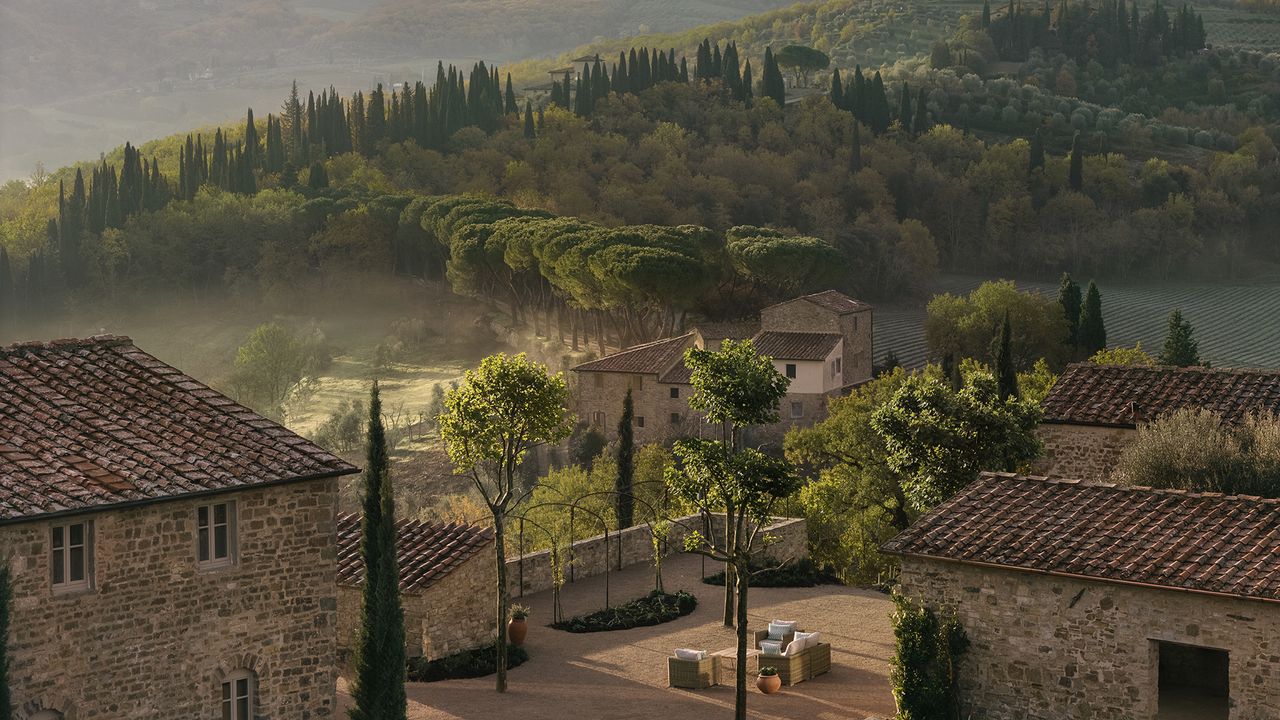
The minibar in the Presidential Tegliaccio Suite at Il Salviatino is embossed with the words Ritz Paris. It came from the hotel’s 2018 auction, as did a table from Coco Chanel’s suite that now sits near the games room in the Fiesole hills.
Neither was sourced by a designer.
Alessandra Rovati Vitali, whose family bought the 15th-century villa in 2018, found them herself. She still arrives at the hotel carrying things she has picked up elsewhere, and the staff have grown accustomed to discovering that a room has quietly changed between stays.
It is a small detail, but an important one. Tuscany has no shortage of beautiful hotels. What separates the memorable ones is increasingly something harder to manufacture: the sense that the place belongs to someone.
For decades, the Tuscan countryside offered two familiar versions of luxury: rent a villa and live temporarily as though it were yours, or check into a historic property converted into a hotel. Somewhere along the way, those models merged.
The villa became the hotel.
And then the hotel became the destination.
Across Tuscany, former castles, monasteries, farming estates and entire villages now operate as self-contained worlds. You can wake beneath a frescoed ceiling, eat tomatoes grown fifty metres from the kitchen, hunt for truffles before lunch, take a pottery class in the afternoon and drink estate wine at dinner without once passing through the gates.
The achievement is considerable.
So is the risk.
When the hotel becomes Tuscany
At Castelfalfi, 2,700 acres contain 146 rooms, four restaurants and more than forty activities, from beekeeping to falconry. Borgo San Felice turned an entire Chianti village into one of Italy’s early alberghi diffusi. At Borgo Santo Pietro, the farm supplies much of what appears in the kitchen and spa; sheep produce the milk for the ricotta, and lavender grown on the property finds its way into treatments.
These places have become extraordinarily good at removing friction from the countryside.
There is always something to do, somewhere to eat and someone ready to arrange it.
But a strange thing happens when an estate becomes too complete. Tuscany can begin to feel like something happening inside the hotel.
The truffle hunt, the olive-oil tasting, the cooking lesson, the vineyard walk: individually, they can be wonderful. Collectively, they have become the standard vocabulary of luxury hospitality in the region. It is now entirely possible to spend four days performing the rituals of Tuscan life without meeting anyone who does not work for the property.
The best hotels seem aware of this.
At Borgo Santo Pietro, a swimming hole in the stream remains open to people from the nearby village. It is a minor detail compared with the acreage, restaurants and elaborate gardens, but perhaps a more meaningful one. The outside world has not been completely edited out.
The luxury of being able to leave
Il Salviatino has an ice bath. It offers a Negroni masterclass. There is a spa built into the villa’s former greenhouse and six suites occupying the old glasshouses.
But its most useful amenity may be the complimentary shuttle.
Florence is roughly fifteen minutes away.
That short drive changes the character of the hotel. You can spend the morning by the pool above the city, disappear into Florence for several hours, then return to Fiesole as the light begins to soften.
The hotel does not have to impersonate Tuscany because Tuscany is still accessible.
Villa San Michele, the former monastery nearby, has long understood a similar rhythm. The architecture, gardens and view are enough. Florence remains below, close enough to enter whenever the mood changes.
Il Pellicano works for much the same reason on the Tuscan coast. It has been a destination since 1965, but it has never needed to turn itself into a miniature agricultural universe to justify staying there. The sea does most of the work.
And in Porto Ercole, La Roqqa has found another way through: its rooftop is not simply a hotel bar but somewhere locals actually go at sunset. That distinction matters.
A hotel becomes more interesting when the life around it is allowed to enter.
Personality over perfection
There is another distinction worth making, and it has little to do with star ratings.
Some estates feel designed. Others feel accumulated.
At Castello di Reschio, just across the border in Umbria, Count Benedikt Bolza and Donna Nencia Corsini spent decades shaping an 11th-century castle and its surrounding estate according to an intensely personal idea of how they wanted to live. The result does not feel as though a hospitality concept was applied to an old building. It feels as though the building slowly became a hotel.
Il Salviatino has the same quality in a different register. Things do not match perfectly. Objects have histories. Furniture moves. The owner might appear carrying something new.
That slight unpredictability is increasingly rare in luxury hotels, where almost everything has been studied, standardized and approved before the guest ever encounters it.
Professionalism makes hotels run beautifully.
Personality makes them difficult to reproduce.
And Tuscany, perhaps more than almost anywhere else, benefits from the latter.
Choosing the right estate
Scale is not inherently the problem.
For families, a large estate can be exactly the point. A property like Castelfalfi can absorb children, long lunches, separate interests and days when nobody wants to get into a car. The infrastructure becomes a form of freedom.
For two people staying a week, the calculation is different.
A smaller estate leaves more empty space in the itinerary. There is less pressure to work through a catalogue of experiences and more reason to drive somewhere simply because lunch sounds good.
That may be the better way to choose a Tuscan hotel now: not by asking how much there is to do inside it, but how easily you can move between the world it has created and the one outside its gates.
Because the great Florentine villas were never intended to be sealed environments. They were built to gather people, feed them, entertain them and send them back out again.
Il Salviatino understands this better than most.
The evidence is everywhere and mostly unimportant: rosemary water appearing each day, a chef cutting sage in the garden in the late afternoon, children wandering back into the breakfast room for another piece of cake.
And, waiting outside, a shuttle down the hill.
Fifteen minutes later, you are in Florence.