The Southwest, Re-Timed: Eighteen Miles of Route 66 at Walking Pace
Albuquerque holds more urban miles of the Mother Road than anywhere in America, and the only sane way to read them is on foot. Add Zion's calendar to the argument and a pattern emerges: in the Southwest, when and how fast now matter more than where.
Under five dollars, tip included, buys a chili cheese dog at the Dog House drive-in on Central Avenue. The menu lists footlongs only, but ask and they will make you a six-inch. The women working the open kitchen split each dog lengthwise before it hits the flattop so it cooks evenly, a detail you learn by sitting at the counter rather than idling at the window. No one driving Route 66 at 25 miles an hour learns it at all.
That is the whole argument, more or less. The American Southwest has spent a century being sold as a distance problem — how many miles, how many states, how many days behind the wheel — and it is quietly turning into a timing problem. When you go and how fast you move now determine what you get. The Grand Canyon of this thesis is Albuquerque, which holds the longest urban stretch of Route 66 in the country: 18 miles inside city limits, on a road that runs 535 miles across New Mexico, more than any other state.
What eighteen miles gives up at speed
A writer for Condé Nast Traveler walked it in June, west to east, starting at Route 66 and New York at 11:45am in 85 dry degrees and quitting under hard rain at 5:17pm. Six hours. The inventory from that day is not a list of attractions; it is a list of things that only exist at three miles an hour.
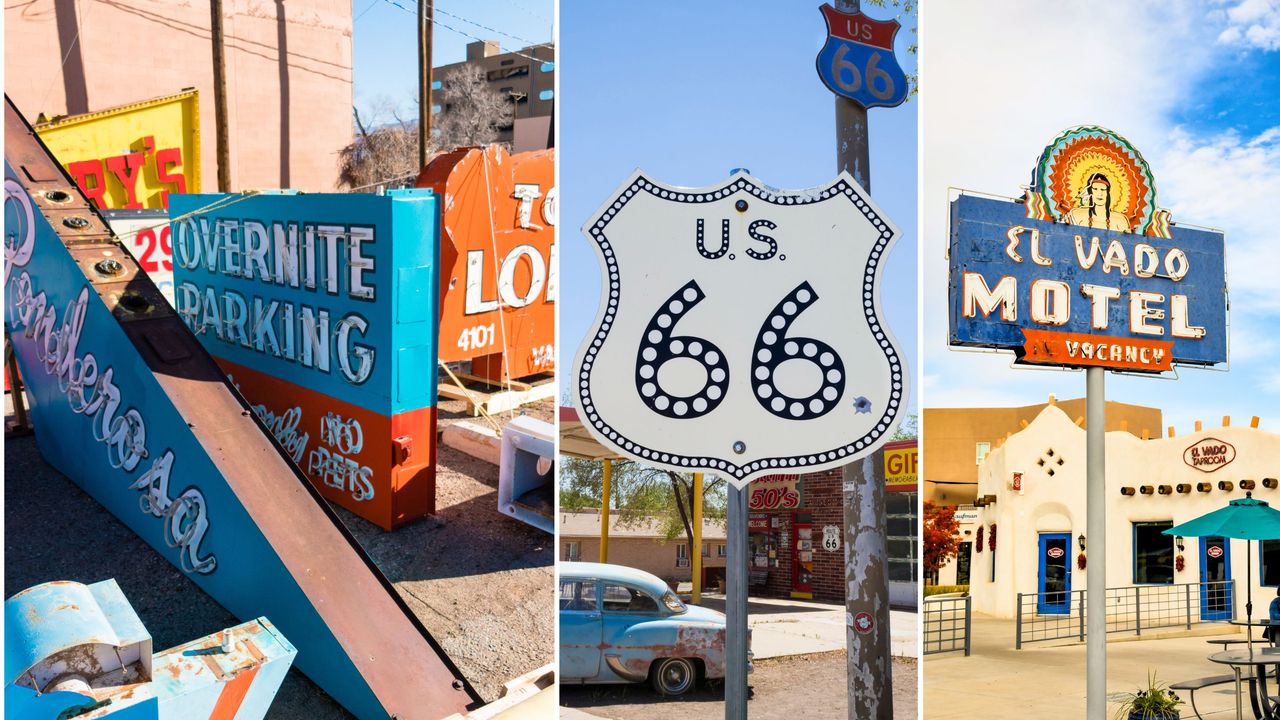
The motel signs first — the El Don with its lassoing cowboy, the El Vado, the Monterey, which has the manners to put "Sorry" ahead of "No Vacancy." Then the Rio Grande Trading Post at the corner where the highway narrows into two-lane Central, which turns out to be, allegedly, the largest purveyor of Native American art in the country, supplying 800 stores. Two employees, Martha and Greg, will tell you about the monthly live sale on Facebook and walk you to Alex Sanchez's silverwork. Across the street, Duran's pharmacy hides a restaurant at the back doing red-and-green chile enchiladas on blue corn. Good Medicine, a tattoo shop in a former filling station, staffs all seven stations with artists born in Albuquerque. At Central and 4th SW, the only place in America where Route 66 crosses itself — 4th followed the original alignment before the 1937 rerouting — a man in a centennial tourist office hands out cold water and period-appropriate playlists. Woody Guthrie for the old route. Buddy Holly for the neon at sundown.
Time moves differently when you're on two feet. So does a city's willingness to explain itself.
None of this is curated for visitors, which is precisely why it works. The same walk also passes an overpass, a hospital and the Crossroads Motel — the "Crystal Palace" of Breaking Bad, now listed for a few million — and the honest verdict is that the stretch from downtown to Nob Hill is not worth your legs. A thrift-store owner named Stue says as much: hop the bus, resume walking where the deco storefronts pick up again near the University of New Mexico campus. He is right. Walk Old Town to downtown, ride the gap, walk Nob Hill. And then, because the neon does not buzz at two in the afternoon, come back down the same road after dark by car. The route rewards two speeds on the same day, which is not how anyone sells it.
Zion, and the tyranny of July
Five hundred miles northwest, the same logic operates on a different clock. Zion takes roughly five million visitors a year across 200-odd square miles, and July delivers daily highs averaging 100 degrees along with the thunderstorms and flash-flood risk that run through August. September and October give you the same canyon with mild temperatures, thinner trails and, by late October, the leaf change. January is emptier still, with highs in the mid-50s and the Watchman Trail in a light jacket — at the cost of ice, closures and the park's wettest weather.
Which reservation is worth the effort? The Narrows in early fall, when the Virgin River is shallow and warm enough to wade and the summer queue has thinned. Angels Landing, permitted, 5.5 miles round trip up a 1,488-foot fin with the last section cut into rock, is a genuine undertaking and most people attempt it in exactly the wrong month. Do it in fair shoulder-season weather or don't bother. Canyoneering runs year-round, but Left Fork and Mystery Canyon go through a seasonal lottery, with other canyons bookable three months out or by a drawing two days before.
The man who passed the walker in Nob Hill in a soaked T-shirt, unhurried while everyone else ran for awnings, had the better read on the weather and the region both. "It starts slow," he said, "then it goes real fast."