The Islands Where Access Is Still a Filter
In Skopelos and Norway’s Træna archipelago, getting there still takes some effort. As Ibiza builds increasingly sophisticated ways to escape its own crowds, these smaller islands suggest that the most valuable luxury may be something a hotel cannot manufacture: a natural limit on how many people arrive.
Skopelos has no airport. To get there, you fly to neighboring Skiathos and continue by ferry, adding another 30 to 45 minutes to a journey that, on paper, could be easier.
In practice, that extra step matters.
It does not keep visitors away. Mamma Mia! made sure of that. Coaches now make their way to the Church of Agios Ioannis, where the film’s wedding scenes were shot, and Kastani Beach draws its own pilgrimage. But Skopelos has never developed the arrival machinery of Mykonos, Santorini or Ibiza. There is no runway feeding thousands of passengers directly onto the island each day.
That difference is visible on the ground. More than two-thirds of Skopelos is covered in Aleppo pine. Skopelos Town still rises from the harbor in a dense stack of whitewashed houses rather than a wall of resorts. Beyond it, roads narrow and twist through forest, monasteries and olive terraces before dropping toward beaches that can still be remarkably quiet outside the height of summer.
Access does not determine everything about an island. But it determines more than most hotel designers would like to admit.
What Ibiza has to manufacture
Ibiza offers the useful counterpoint because almost nothing about arriving there is difficult.
The island has spent decades absorbing volume, and its newer hotels increasingly respond not by limiting that volume but by creating smaller, more controlled worlds within it.
Hotel Mongibello, on the quieter east coast at Siesta, is a particularly polished example. It has 167 rooms, including 32 suites named after artists, architects and DJs associated with Ibiza, and commits enthusiastically to an Italian fantasy: ceramic cups, rotary telephones, a Sicilian chef, Francesco T. Leggio, cooking carbonara and sea-urchin cacio e pepe, and a nightclub called Lola’s hidden behind a concealed door. Rates start around €260 for a deluxe room with a balcony.
It is clever, theatrical and more specific than the usual Mediterranean resort pastiche. But its privacy has to be designed.
That distinction matters.
On an island built to receive people at scale, luxury increasingly means constructing boundaries after everyone has arrived: the hidden beach club, the private pool, the members’ room, the concealed bar, the villa behind the gate.
On smaller islands, geography sometimes establishes the boundary first.
Built with the village rather than beside it
At the far end of that argument is Træna, an archipelago of 477 islands off Norway’s Helgeland coast.
Ytri Island Retreat opened in April on Husøya with just 38 rooms and suites. Reaching it from Bodø requires a long journey by sea. That inconvenience is not incidental to the experience; it shapes the scale at which tourism can happen here.
More interesting than the hotel’s size, however, is how it came to exist.
The idea for higher-end accommodation emerged locally roughly a decade ago, as the municipality and development company Træna 365 considered how tourism might contribute to an island community facing the economic and demographic pressures familiar across remote coastal settlements. Years of planning followed before investors Asle Helgheim and Ellen Hestenes, sailors who already operated a spa hotel in Sweden, joined the project.
That origin matters because Ytri is not simply a resort that selected a dramatic island as its backdrop. It is part of a broader attempt to make living on the island viable.
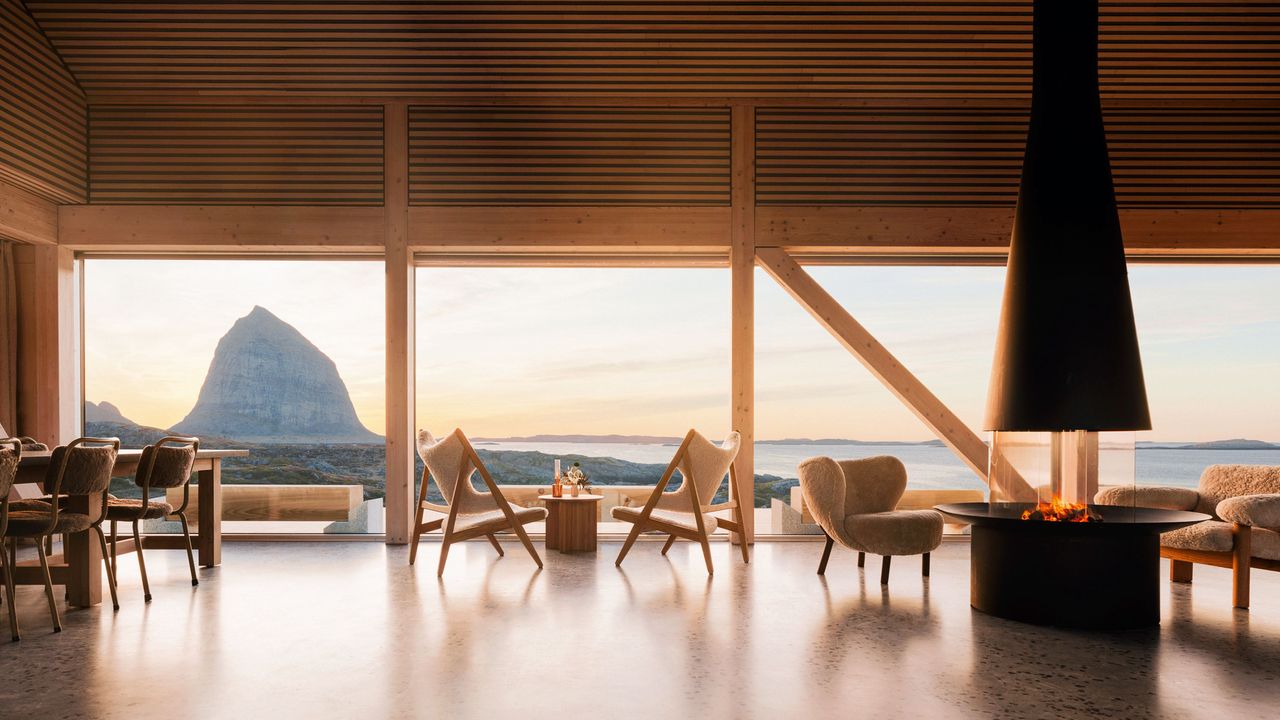
The architecture follows the same logic. Rooms are restrained rather than performatively rustic: high-pitched ceilings in pale wood, Norwegian wool in deep blues and greys, terrazzo incorporating local sand, stone and shells, and floor-to-ceiling windows angled toward the jagged Trænstaven mountains rising from Sanna across the water. Outside, garnet, mint and silver reference the colors of local fishermen’s houses.
The boundary between hotel and island is deliberately porous. One of Ytri’s activity guides, Anders Budde, is a water engineer who moved to Træna seven years ago and free-dives for scallops and kelp that can later appear on the menu.
At Alma, the hotel restaurant, a four-course dinner begins with a brown-butter candle designed to be eaten with bread, a reference to the beacons once used by sailors. The chef’s table pushes the idea further with a 12-course menu connecting Træna to places along historic and imagined sea routes.
The seating is communal.
That detail may say more about Ytri than the wool, terrazzo or view. Nine strangers share the table. The village pub is part of the experience. The island itself is not something guests are meant to observe entirely from behind hotel glass.
Remoteness works. Until it doesn’t.
There is an obvious temptation to romanticize all this.
Limited access can suppress volume, but it does not guarantee good tourism. Ferry capacity can increase. Cruise ships can arrive. Private boats can bypass public infrastructure. At Ytri, private helicopter transfers from Bodø can already be arranged, while Hurtigruten ships bring day visitors into the archipelago.
Remoteness is doing some of the heavy lifting, and remoteness leaks.
That may be the more important lesson from places such as Lofoten, where extraordinary landscapes and improved accessibility have brought increasing tourism pressure to communities that once seemed protected by distance alone.
The paradox is simple: the more valuable difficulty becomes, the more money there is in removing it.
A remote island becomes desirable because few people go. Hotels arrive because few people go. Transport improves because more people want to go. Eventually, the characteristic that created the value begins to disappear.
The question for Træna is therefore not whether it can attract visitors. Ytri suggests that it can.
The question is whether it can attract enough of them to support the community without building the infrastructure required to attract everyone else.
Skopelos has been testing this for years
Skopelos offers a less deliberate version of the same experiment.
Heather Parsons of Skopelos Walks has spent decades helping recover old shepherds’ paths that predate the island’s modern roads. Today, roughly 125 kilometers of waymarked trails cross pine forest, monasteries and old agricultural terraces.
The island’s newer hospitality is beginning to work with that landscape rather than attempting to replace it.
Minno Boutique Hotel & Spa, opened in summer 2025, sits about a ten-minute walk from Skopelos Town, with a pool and spa overlooking the harbor. Its restaurant also welcomes non-residents, a small but useful indication that the hotel sees the town as part of its audience rather than scenery outside the gate.
Chef Dimitris Charitidis takes familiar island dishes and loosens their form without erasing their flavor. Stifado becomes a fillet with caramelized onions and spiced jus. A coq au vin croquette arrives with corn hollandaise and somehow makes sense.
None of this means Skopelos is untouched.
The Mamma Mia! effect is real. Agios Ioannis can fill with visitors climbing the roughly 200 steps toward the chapel. Kastani Beach attracts the film crowd. In August, the island is hardly undiscovered.
But drive north instead toward Perivoliou and the distinction becomes clearer. The roads get narrower. The forest closes in. The final descent requires attention. Outside peak season, you may reach the water and find remarkably few people there.
The inconvenience is minor.
That is precisely why it works.
The luxury no one can design
For years, luxury hotels have tried to create exclusivity through architecture: fewer rooms, larger suites, hidden entrances, private beaches, villas removed from the main building.
All of those things can work.
But Skopelos and Træna point to something more fundamental. Sometimes the most effective form of low-density tourism exists before the architect arrives. It is embedded in ferry schedules, geography, weather and the simple fact that getting somewhere requires another decision.
Ibiza shows what happens when that friction largely disappears: sophisticated hotels become very good at putting it back.
The challenge for islands such as Skopelos and Træna is different.
They already have it.
Their advantage will depend on knowing how much of it not to remove.
GOOD TO KNOW
Skopelos, GreeceThere is no airport on Skopelos. The usual route is to fly to Skiathos and continue by ferry. Minno Boutique Hotel & Spa opened in summer 2025, around a ten-minute walk from Skopelos Town, and its restaurant welcomes non-residents.
Træna, NorwayYtri Island Retreat opened on Husøya in April 2026 with 38 rooms and suites. The archipelago lies off Norway’s Helgeland coast and is reached primarily by sea from the mainland. Alma offers a four-course dinner as well as a 12-course communal chef’s-table experience.
Ibiza, SpainHotel Mongibello is in Siesta, near Santa Eulària on Ibiza’s east coast, with 167 rooms and suites and an Italian-inspired concept.