Sailing the Odyssey in 2026: the Riviera di Ulisse and the rest of the route
The 46-mile coast between Monte Circeo and Gaeta has no luxury resorts, which is precisely why Romans keep it. A case for stringing it together with Ponza, Procida and Stromboli, and a hard look at what the Aegean packages are actually selling.
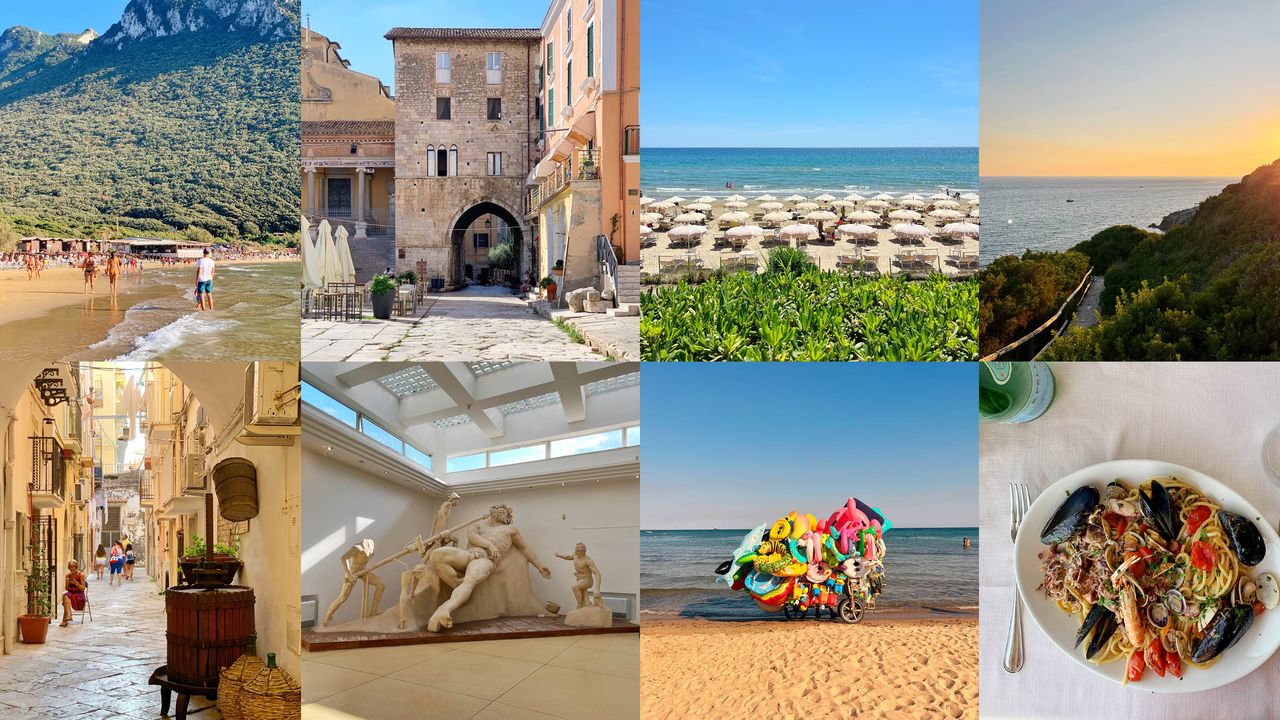
The statue of Polyphemus that dominates the museum beside the Villa of Tiberius at Sperlonga did not come out of a planned excavation. It turned up in 1957, when crews cutting the Via Flacca, the road that finally linked these towns to one another, broke into the emperor's grotto. Tiberius, who ruled from 14 to 37 CE, had furnished a dining cave hollowed into the cliff with the cast of the Odyssey: the cyclops, Scylla and Charybdis. Roman holidaymaking on this coast is roughly two thousand years old. The infrastructure to support foreign holidaymaking is about seventy.
That gap is the whole point. The Riviera di Ulisse runs some 46.5 miles from Monte Circeo to Gaeta, and it contains no luxury resort. None. There is no Belmond, no Four Seasons, nothing to pull the international set off Capri or out of Positano, and so the stretch has stayed roughly where the Amalfi Coast was in 1962: rocky platforms where people lay their towels and dive off, pastel buildings over a working port, family restaurants doing spaghetti alle vongole without irony. Anyone who books a coast expecting a 24-hour spa and a butler floor will be unhappy. Anyone who has had enough of both will not.
What is actually worth the drive
The towns divide cleanly. Sperlonga is the picture: whitewashed hill town, golden sand below, and now a set of murals through the lanes illustrating scenes from the poem, one of them framing the beach through an arch with Ulysses's ship painted round it. Terracina has the ruins, a surviving segment of the Appia Antica and the Temple of Jupiter Anxur on its promontory, with sightlines down the length of the coast. Gaeta has the medieval quarter, the olives, and tiella, the local savoury pie, filled either with stewed octopus and tomato or with escarole and olives; buy it at a bakery and eat it by the marina rather than sitting down for it. Formia and Gaeta were the celebrity coast between the 1950s and the 1970s, when Alberto Sordi, Gina Lollobrigida, Pino Daniele and Cy Twombly all bought houses here.
Two reservations justify the effort. Lunch at Saporetti in Sabaudia, a wood-panelled beach shack that appears not to have been touched since the 1960s, is the closest thing this coast has to a scene: Roman businessmen and politicians in swim trunks, fritto misto, clams, and the mountain throwing its shadow over the sand. Dinner at the Hotel Punta Rossa in San Felice Circeo is the other, all whitewash and tile, glamorous in an old and unbothered way. Da Mario l'Ostricaro in Terracina holds up. The fishermen's cooperative in the same town does not: it expanded, and the cooking went with it, which is the standard trajectory here and worth remembering before you chase a tip that is five years old.
There is no luxury resort along the entire 46 miles, and that is the reason the coast still works.
The island legs
Ponza is the mythological prize, or one of two claimants: scholars place Circe's Aeaea on the island, while local lore on the mainland gives the honour to Monte Circeo, which rises over Sabaudia and San Felice Circeo and would have read as an island when the marshes still surrounded it. Take your pick. Ponza itself has white cliffs, almost no cars, very few hotels (Chiaia di Luna is the one people name), and is best worked by hiring a small motorboat with a skipper for a day or two, with a lunch at La Marina above Cala Feola and a crossing to Palmarola if the sea allows. It is also the one place on this coast where prices have moved fast enough for local radio to complain about it.
South, the logic holds. Procida is four square kilometres and an hour by boat from Naples, with Marina di Corricella reachable only on foot, the refurbished Fishermen's Houses to sleep in, and Il Pescatore on the harbour. Stromboli, further on, is the outlier worth the effort: black sand, steaming hot springs, serious hiking, a handful of quiet hotels around San Vincenzo and Piscita, and far fewer people than the other Aeolians it serves as a base for.
The Aegean leg, honestly
The Homeric landfalls east of Italy are being sold hard. Following the July release of Christopher Nolan's film, British Airways Holidays recorded searches up 21 per cent for Turkey and 16 per cent for Greece over 40 days against the same window a year earlier. What is on offer, though, is resort weeks, not a route: Halkidiki, Santorini, Kalamata, Fethiye. October dates are the intelligent part of it, the shoulder month when the Aegean is still swimmable and the Cyclades are navigable on foot. Just do not confuse a seven-night all-inclusive with a voyage.
The murals in Sperlonga are new, and they are the first sign in decades that this coast has noticed what it is sitting on. Give it another ten years and someone will build the resort.