Noury Puts the Bar in the Middle of the Room
Alex Chang and Lina Goujjane's second Soho restaurant seats 39 around a five-stool wine and sake bar. Studio Tre's interior argues the case before the kitchen says a word.
Five seats. That is the size of the wine and sake bar at Noury, and it sits at the centre of the room rather than along a wall, which for an izakaya is close to heresy. The traditional arrangement puts the counter down one flank, facing the pass, so the cook and the drinker share a working surface. Here the counter is an island in a 39-seat room, faced outward, and the thing behind it is bottles rather than a grill. That single decision tells you what Noury thinks it is: a drinking place that feeds you seriously, not a restaurant with a bar programme bolted on.
The restaurant is the second project from chef Alex Chang and sommelier Lina Goujjane, a married pair who already run Kiko, an Asian-American room in Hudson Square. The second-restaurant move here is the familiar and usually correct one: go smaller, go tighter, let the beverage list do more of the work. Thirty-nine covers with five of them at a bar is not a scaling exercise. It is a bet that a small room in Soho, turned twice on a good night, can carry a kitchen doing precise Japanese technique on produce that never crossed the Pacific.
Where the money went
Studio Tre, based in New York, kept what was already good. Existing limestone and oak beam flooring was preserved and refreshed. The brick walls stayed and were painted a warm muted stone. That is the correct order of operations in a building with a past, and it frees the budget for the surfaces guests actually touch.
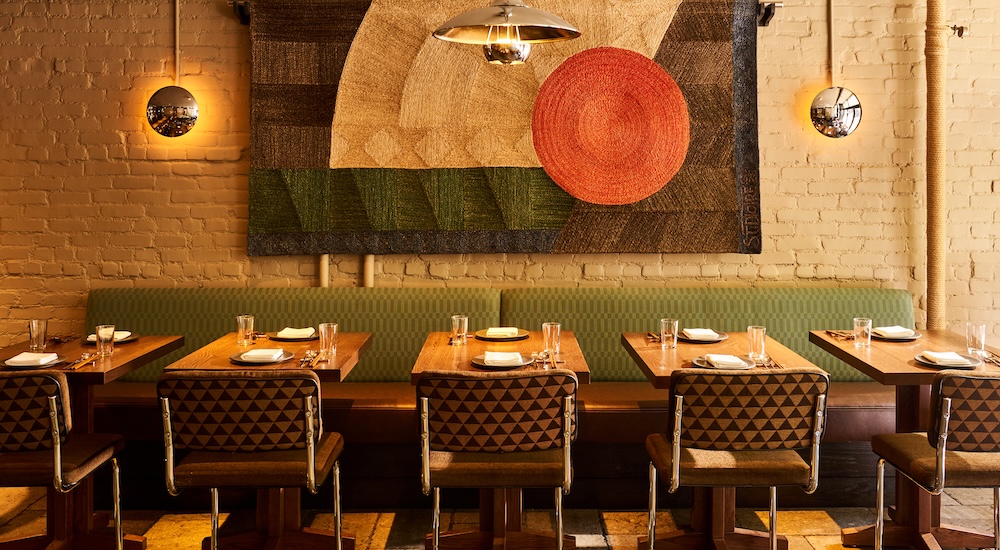
Those surfaces are where the spending shows. Chivas quartzite, quarried in Brazil and given a leathered finish, runs across the bar countertop, a corner table and various accents, its black veining moving through brown. Ebonized oak beams are infilled with panels of raffia and linen, a tatami reference made in materials no tatami maker would recognise. Banquettes are chocolate brown mohair; the chairs are woven raffia and linen, piped in black leather. Dark fumed white oak and ebonized black wood meet stainless steel panelling at the bar and on the wall. An end wall of Mexican cantera volcanic lava stone, trimmed in steel, steps back to frame a niche built for ikebana.
On paper this is a soft room. Mohair, raffia, linen and woven abaca absorb; a 39-seat space full of those materials tends to stay conversational at capacity rather than tipping into the flat roar that makes small Manhattan dining rooms exhausting after ninety minutes. The stainless steel and the quartzite push back the other way. Whether the balance lands is the sort of thing you know within four minutes of walking in, and it matters more to the experience than any of the finishes do individually.
The risk in the shopping list
Count the origins: Brazilian quartzite, Mexican lava stone, a handwoven abaca tapestry made by WeaveManila artisans in the Philippines, vintage sang de boeuf Chinese pottery, Persian turquoise, verdigris bronze pendants retrofitted as sconces in the restroom. In a room this size, that inventory could easily read as a curio cabinet, the design equivalent of a menu that lists yuzu and burrata in the same sentence and hopes nobody asks why.
What holds it together, if anything does, is that the palette has a single governing note. The verdigris patina on those bronze pendants was the original reference for the whole colour scheme, and you can trace it outward: the muted stone brick, the browns of the mohair and the quartzite, the cool grey of the steel. Discipline about colour is what allows promiscuity about provenance. The ikebana niche is the one gesture that commits unambiguously to Japan, and putting it in cantera lava stone rather than plaster or wood is the sharpest joke in the room.
Discipline about colour is what allows promiscuity about provenance.
What we still do not know
No dishes have been published. No shape to the wine and sake list, no indication of markup, no word on whether the format is a long sequence of small plates or something closer to a set progression. The announcement is entirely about the room, which is a reasonable way to open a restaurant whose thesis is legible in its materials, and a slightly nervous one for a kitchen whose whole proposition is technique.
That is the part worth watching. Japanese method applied to Western produce is not a new idea in New York, and the version of it that fails does so in a predictable way: the knife work is immaculate, the sourcing is local and proud, and the seasoning is timid because nobody wanted to overwhelm a tomato that cost eleven dollars. The version that works treats dashi and cure and char as tools rather than as citations.
Book the counter. Five stools facing a sommelier who co-owns the place is the best-value reservation in any restaurant built this way, and in a 39-seat room those seats will go first.