Greece Redraws Its Map, and the Best of It Is Inland
A 1,200-mile trail network, a Bronze Age dialect on the street signs of Leonidio, a November running festival at Costa Navarino: the country's most interesting new product is happening away from the caldera.
Nobody built the Peloponnese Trail Network. The paths were already there - mule tracks, Ottoman-era stone paving, the routes children walked to school in the 1940s - and the work of the past three years has been mapping, clearing and signing them, then persuading villages of two hundred people that walkers are worth having. Eleven official trails are open. Together the network runs to nearly 1,200 miles, which makes it the largest in Greece, and most of it lies outside Messinia, the region Christopher Nolan's cameras have just made famous.
The scale of the opportunity is in one statistic: of every hundred foreign travellers who came to Greece in 2025, three reached the Peloponnese. A peninsula the size of Slovenia, three hours from Athens by road since the tunnels and highways went in, and it has been effectively invisible.
Walk the Parnon, not the postcard
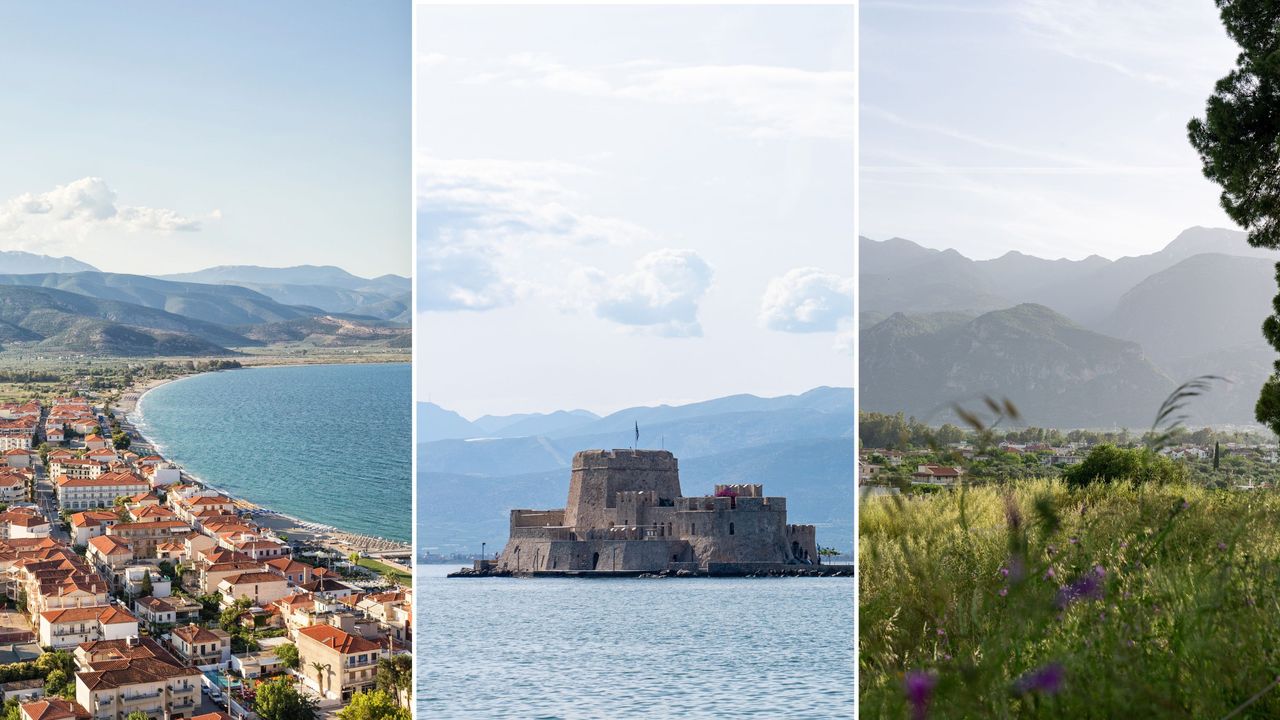
The Argolis Trail, 64 miles in the northeast, is the easy sell. It passes Epidaurus, where in the fourth century BC performances were prescribed to patients as treatment, and climbs Ottoman stone stairs to Palamidi, the Venetian fortress above Nafplio. Good walking, heavily underwritten by monuments.
The Parnon Trail is the better reservation. It runs 143 circular miles through a range visible from Athens on a clear day, and the section out of the Tsakonian village of Pera Melana takes about four hours before dropping toward Leonidio, a town of 4,000 wedged under red limestone cliffs that have turned it into a serious sport-climbing destination. Rosemary, thyme, oregano and sage grow wild along the path; cedars above, lemon and olive below, then mountain cherry and juniper. The signage is new enough that you could do it alone. Don't. The value here is a guide like George Alexandrou, whose father used these paths to get to school, and who stops at the chapel of Prophet Elias to hand out walnuts, oranges and koulourakia baked with local oil and citrus zest.
The paths are three thousand years old. What is new is that someone painted the waymarks.
The dialect, honestly
Leonidio is being sold to visitors on the strength of Tsakonian, the dialect its residents speak as direct descendants of ancient Spartans - a language older than modern Greek by roughly three millennia, preserved because the Parnon range kept these villages sealed off until roads arrived in the 1950s. Fewer than a quarter of the 10,000 Tsakonians still carry it, most of them elderly. Eleni Manou, an author and educator in the town, publishes children's books in it and runs workshops; a July festival puts the traditions into present tense; the street signs are now bilingual.
Nobody should book a flight expecting to learn a Bronze Age dialect in an afternoon. What you can do is hear it spoken by people for whom it is not a heritage exercise. The parallel workshop worth the detour is at Geraki, over in Laconia, where Chrysoula Stamatopoulou teaches weaving on a vertical loom - the craft is on the national intangible heritage register, women in the village have worked this loom for 5,000 years, and tuition is free. Five years ago she was the only weaver in the room. Geraki and Leonidio are the only two places that teach it.
Messinia gets a race
The other half of the story is resort-shaped. Costa Navarino, the project Vassilis Constantakopoulos began as a way of stopping the emigration from his birthplace, now leases land to W Hotels (2022) and Mandarin Oriental (2023), with Four Seasons and Six Senses expected. Nolan filmed nearby - Nestor's Cave, Methoni Castle - and into that attention comes the Greek Odyssey Running Festival: a half-marathon and a 10K, based at the five-star Westin, staged the weekend after the Athens Marathon so runners can double up. Two packages, both including breakfast, excursions and group transfers to and from Athens. Note that the announcement gives the date as Saturday 14 November 2026 while quoting Brendan Fox of Destination Sport Experiences on welcoming the first runners "this November" - worth confirming before you book flights.
A 10K past a golf coast is not a reason to cross an ocean. Mid-November in Messinia, warm and effectively empty, is. The race is a pretext for shoulder-season occupancy, which is exactly what this coast needs.
Where the islands still work
The same logic - friction as a filter - explains Gundari on Folegandros, an island with ferries and no airport, 27 suites and villas cut into a southeastern clifftop about twenty minutes from Chora. Every room has a sea view and a private pool; the cave suites, carved into the rock, get the best of both plus turntables and stocked bars. Lefteris Lazarou runs the restaurant, Orizon, off an organic farm and local boats. The spa's brief is restorative rather than medical, built on wild herbs from the hills above. Santorini is 50 minutes away by fast ferry and there is no reason to go.
Andros makes the cheaper version of the argument: an hour from Athens, green, mountainous, more Greeks than foreigners, roads that require nerve. A two-bedroom rental in the Kalamaki settlement with an outdoor brick oven, a carob tree for shade and a cove shared with one neighbouring house does what Gundari does for a fraction of the money, minus the chef.
In Laconia, Vamvakou was down to nine year-round residents. Four young people with roots there have brought it back to thirty. Nearby Lasta has none.