Craft as Structure: How Rabat and Riyadh Are Being Built From Local Pattern
Roar abstracts Amazigh weaving into the architecture of Story Le Carrousel Rabat while LW turns Najdi textiles and Al Sadu geometry into a 210-key W at Riyadh's financial district. Two answers to the same brief, and one telling blind spot.
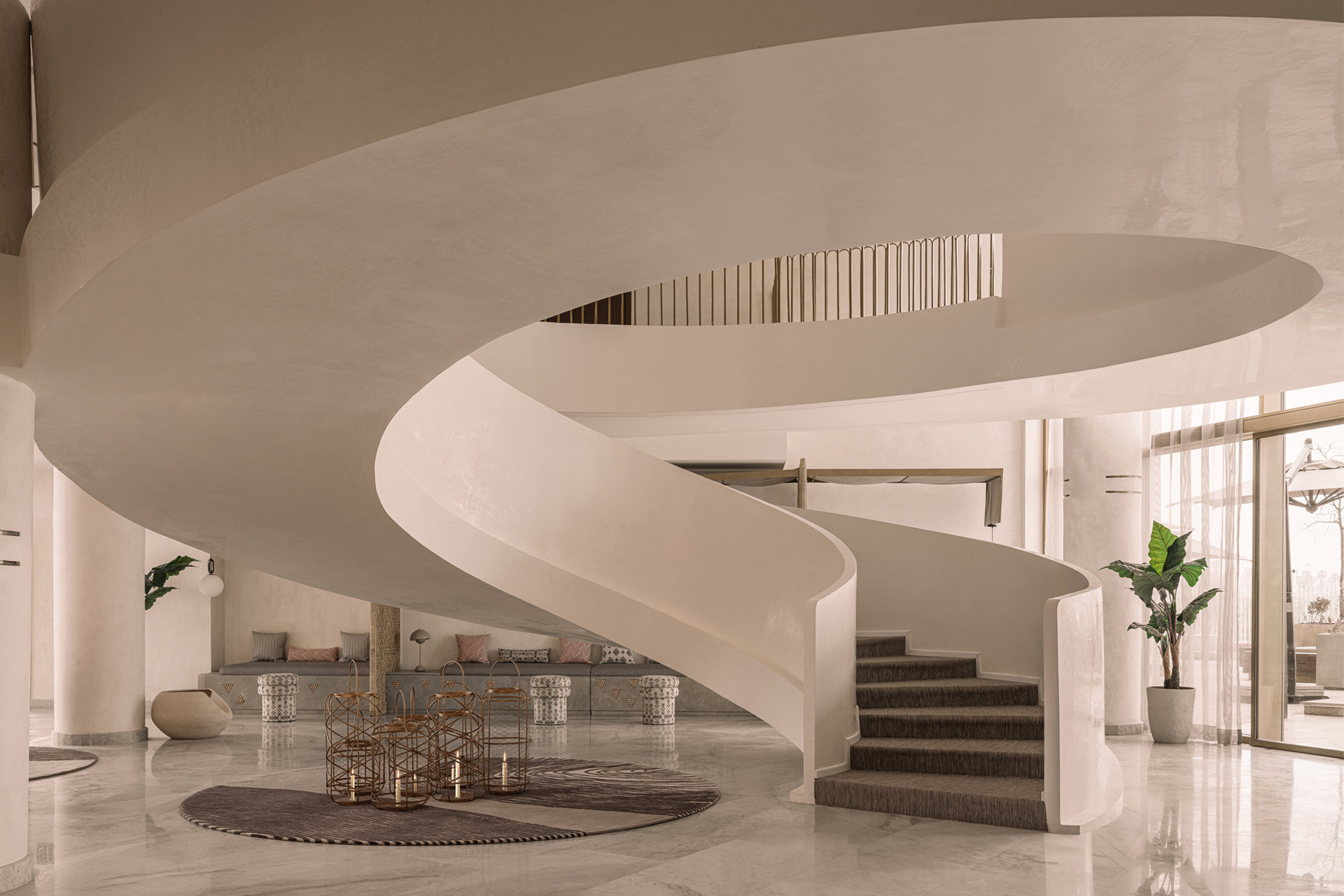
The most interesting decision at Story Le Carrousel Rabat is a ramp. It runs through the lobby, sculptural rather than merely accessible, and it exists to slow arrival down — a procession borrowed, Roar says, from the caravan routes that once crossed this part of North Africa. Circulation as narrative. Whether it works depends on details the design concept does not yet disclose, but the intent is clear enough: the hotel wants to be walked through, not checked into.
Two projects released within weeks of each other make the same argument from opposite ends of the Arab world. In Rabat, Pallavi Dean's Roar is drawing a coastal hotel out of Amazigh craft. In Riyadh, LW has delivered the 210-key W Riyadh – KAFD, the brand's first property in Saudi Arabia, from Najdi textile traditions and the geometry of Al Sadu weaving. Neither is importing glamour. Both are mining what is already there. The question is what happens to a weaving tradition when it becomes a wall.
Rabat: heritage held at arm's length
Dean's stated ambition is restraint. "We wanted to distill Amazigh heritage into something more abstract and architectural, where culture is felt through space rather than explicitly shown," she says — which is the correct instinct and the hardest one to execute, because abstraction is only one bad client meeting away from wallpaper.
The mechanics are more convincing than the manifesto. Traditional weaving techniques are enlarged into wall reliefs, so the craft is in the surface rather than hung on it. The geometric logic of Berber rugs sets out floors, wall patterns and joinery. Tuareg jewellery and protective amulets are reworked as wayfinding and signage, which is a genuinely clever move: an object that once travelled on a body becomes the thing that tells you where the ballroom is. Rabat embroidery informs the tonal, quieter surfaces; Fez embroidery, with its mirrored and layered geometries, does the more intricate work. Guestrooms go muted and face the Atlantic without interruption.
Craft becomes structure, symbolism becomes navigation. It is a good line. The kitchen has not heard it.
The rooftop is where the concept relaxes into commerce — live cooking, music, an atmosphere designed to shift across the evening — and the specialty restaurant draws on Spanish cooking reinterpreted through Moroccan flavours. Fine. But it is worth noticing that a hotel built entirely from Amazigh material culture has chosen Spain for its flagship table. No key count, no rate, no opening date has been published. Judge the ramp when it exists.
Riyadh: the tapestry earns its place
LW's approach at KAFD is less interested in dissolving its references. The entry sequence is anchored by a tapestry of nearly 20 feet by the Saudi artist Abdulnasser Gharem, with floor-to-ceiling curtains alluding to the early stages of weaving — commissioning an artist rather than abstracting a motif, which is the more durable strategy. The W Lounge borrows from Bedouin gathering, circular banquettes and sunken tables arranged as a fire pit would be. That reads as a plan, not a mood board.
The room count breaks down as 210 keys including 17 suites, two penthouse suites and the W Penthouse, which runs to roughly 4,200 square feet with two bedrooms, separate living and dining, a kitchenette, an office and a gym with steam and sauna. Its floor-to-ceiling installation of wooden and illuminated spheres references Subha prayer beads. Standard rooms take green, ruby, gold and bronze, with geometric textiles and wall art in both English and Arabic typography — the bilingual detail is small and it matters more than the palette.
Food and beverage tells you where the confidence runs out. Sira cooks a Latin American menu over open fire in an open kitchen, with a bar built around mocktails; Beni is the all-day coffee and ice cream room; WET Deck does Mediterranean food and cabanas; Sahari, an outdoor lounge for performance, arrives later this year. So the building speaks Najdi and the menus speak Lima and Liguria. That is the same gap Rabat leaves open, and in both cases it is the easiest one to close.
AWAY Spa and the FIT studio are present and, in the material released, barely described — a treatment menu and training technology, no protocol, no duration, no thermal circuit, no word on who is on the beds. For a 210-room hotel in a financial district with 15 meeting rooms and a ballroom, the spa is the amenity most likely to be used at seven in the morning and least likely to have been thought about.
That regional pipeline is now deep enough to be reorganising the design firms themselves: HBA has moved partner Rahul Shankhwalker from Singapore to Dubai to add senior leadership across hospitality, residential and mixed-use. Twenty-five years of Asia-Pacific work, redirected to the Gulf. The talent is following the drawings.